Thursday, October 3, 2013

West Hollywood Art Walk

West Hollywood is both a creative city and a walking city! It is one of the few 'neighborhoods' in Los Angeles where you can actually walk to the grocery store, the bank, the post office, the dry cleaners, the gym, the bar, the library, and the museum, all within a few block radius. It is also the 'gayborhood', full of diversity and creativity! So what better way to enjoy a beautiful walk through the city than by taking in some of the numerous public art exhibits!

James Surls, "Eye Flower", West Hollywood by Alton DuLaney
So let's start our walking tour of West Hollywood where I started my own wild fascination with Art with a capital A, in the piney woods of Splendora! Growing up in the tiny-Texas-town of Splendora, art seemed a world away, at least until I met and then interned with James Surls. This world-renowned sculptor called Splendora home from 1977-1997, and even published a book, The Splendora Years, to commemorate his time there. 

Now that I live in West Hollywood, whenever I am missing my home town, I stroll up the hill to Sunset Plaza, and there nestled between shops and cafes, is a larger than life James Surls sculpture from 2002, entitled "Eye Flower". Incorporating two of Surls' reoccurring motifs, the eye and the flower, it is a magnificent and yet unexpected artistic statement, towering there in the plaza, casting fanciful shadows upon unsuspecting pedestrians as they  move about or pause to enjoy a magazine or cup of coffee.

From here head east on Sunset Boulevard, and make a right down the steep hill that is La Cienega. Just before reaching Santa Monica Boulevard, make a left onto Holloway and look for the Barney's Beanery.

Richard Artschwager, "BLPs", West Hollywood, by Alton DuLaney
This is unquestionably the most subtle artistic statement in West Hollywood, but like most art, it must be taken in context. If you look very closely at the Barney's Beanery sign, you will see in the upper rightt-hand corner, one of Artschwager's famous black lozenge-shaped marks, known as a BLP.  Artschwager developed this artistic statement in the 1960's to inspire focus, and to draw the viewers eye to things we might otherwise overlook. 

Artschwager famously used his guerrilla techinique at his Whitney Museum exhibit in 1968, placing 100 of his BLP's throughout the museum, drawing attention to the brutalist architecture of Marcel Breuer who designed the museum. 

The Hammer Museum recently presented a retrospective of the artist, who died in February 2013, and as part of the exhibit, BLB's where installed across Los Angeles including at least 4 that I spotted in West Hollywood. (In conjunction with the Whitney Museum of American Art, BLP's were also installed in Los Vegas and in NYC!)  

Artschwager once explained that his BLP's were inspired by the exclamation point, which is my favorite punctuation!
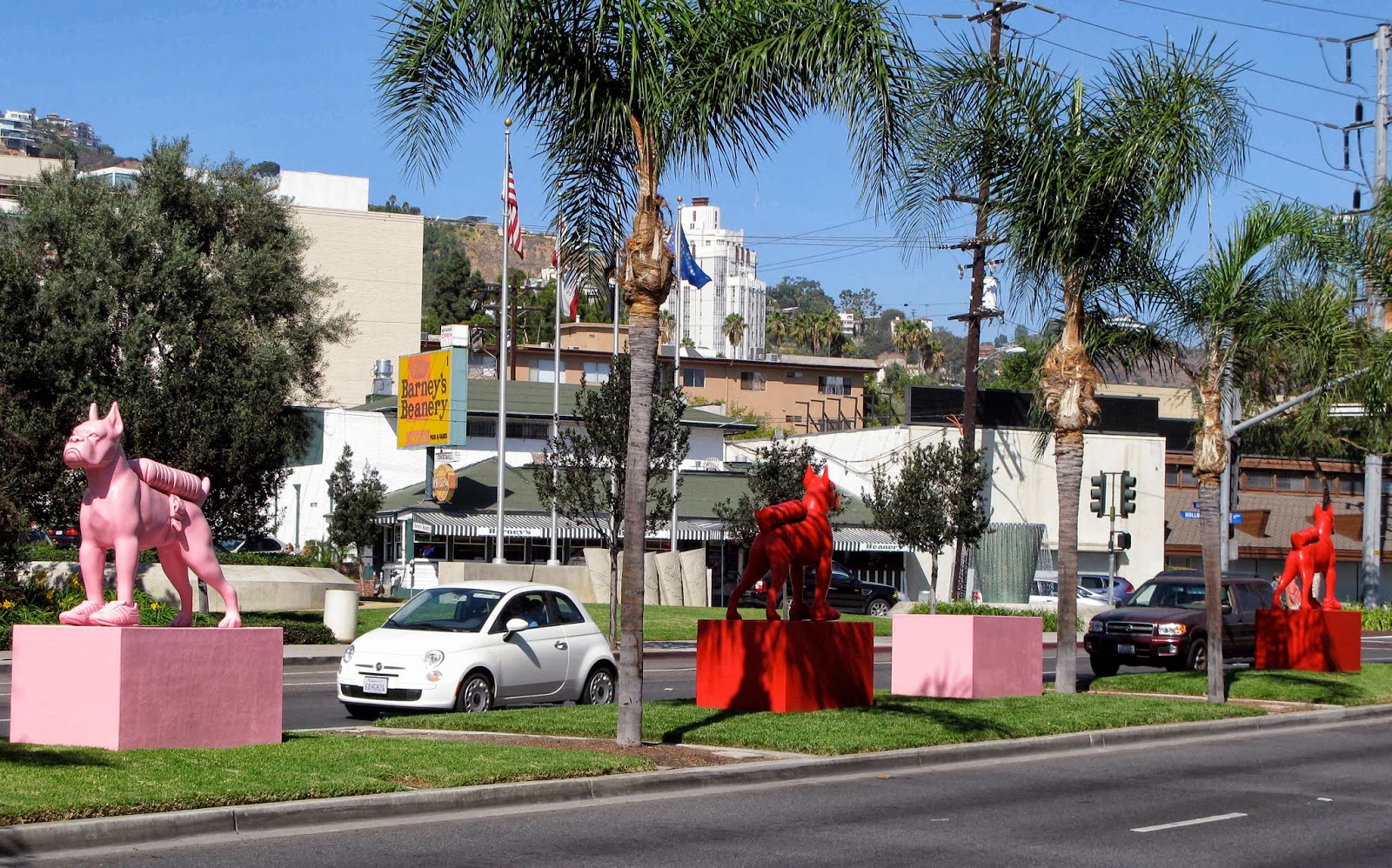
William Sweetlove, "Cloned Dogs with Water Bottles", West Hollywood, by Alton DuLaney

 Speaking of something to get excited about, just across the street is evidence of the great art heist of West Hollywood 2013!! The Belgian artist, William Sweetlove, installed his colorful sentry of "Cloned Bulldogs with Water Bottles", (a statement on climate change), earlier this summer along the grassy knoll of Santa Monica Boulevard just in time for the annual Gay Pride Parade in June. Each of his bulldogs with base loom over 9 feet tall, and weigh several hundred pounds. When the dust and glitter from the Gay Pride Parade settled, imagine the surprise of city officials when they discovered that one of the statues had been 'dog-napped'! Despite a thorough investigation including posting lost-dog signs around West Hollywood, and a reward offered from the artist himself, the missing pink bulldog was never located. The empty pink base stands as a forlorn reminder of this summer caper!

From here, let's walk west along Santa Monica Boulevard, admiring the cafes that dot the sidewalk and the breeze that rustles through the palm trees. In a few blocks you will come to Hancock Avenue. A few parking spots up on the right side of the street, lost amongst the perplexing array of signage that has resulted in more than a few of my guests being ticketed or towed, is perhaps the most poetic of public art to be found in West Hollywood.

Rebecca Lowry, "Regard" West Hollywood, by Alton DuLaney
Rebecca Lowry is an artist with a background in architecture, and a kindred spirit who enjoys a fanciful play on words. Her street art Haikus are scattered around West Hollywood and displayed in multiple languages to exemplify the cultural diversity of our fair little city, where election ballots are printed in both English and Russian! This one on Hancock is my favorite, as it is testament to the beauty of words, and  mere footsteps from where I live.

Now before we get too lost in deep contemplative thought, let's venture farther west on SMB taking in the other famous art forms of West Hollywod, the beautiful men who call this their home and playground. The bars and boutiques of the next few blocks are collectively referred to as 'Boystown' and it doesn't take an aesthete or art historian to figure out why.

Now if you make a left at the Rainbow Crosswalk on St. Vicente, you will see looming in the distance the iconic Pacific Design Center - three epic glass structures in red, green and blue. The PDC is home to countless design firms, galleries and the Museum of Contemporary Art (MOCA), should you require a respite from the sun. But for now, I suggest that instead you veer into the West Hollywood Park on the opposite side of the street and head back behind the tennis courts to a lost little corner where you might notice a few figures against a green wall.

Ramiro Gomez, "The Caretakers: :Los Cuidadores", West Hollywood, by Alton DuLaney
 These characters are actually a figurative mural by West Hollywood based Latino artist Ramiro Gomez. His work aims to draw attention to the invisible people in our community who help keep our thins beautiful and clean - the gardeners, nannies, valets, and house keepers, who are typically Latino, and typically under-represented. Gomez, who claims to have worked as a nanny himself, fashions his paintings after amalgamations of other staff he has met. These three ladies are Daisy, Elsa, and Lacy.

Cosimo Cavallaro, "love Your Beans", West Hollywood, by Alton DuLaney

Another Latino artist, who's work is much more visible, is Cosimo Cavallaro. His gigantic, brighly colored jelly beans are hard to miss, as they lounge beneath one of the park's many expansive tree. Cavallaro, who normally works in the perishable medium of food-stuffs, collaborate with master fabricator Jack Brogan to create these brilliant giants with a much longer shelf-life. Over the last few weeks, I have watched kids, young and old, frolicking around and stroking the smooth surface, as they marvel at this fun installation.

Liz Craft, "The Temple of Folly", West Hollywood, by Alton DuLaney

 A few steps farther down on St Vicente, and the astute viewer encounters the temple where all artist worship. No not a church, but "The Temple of Folly"! This tee-pee-like structure, by artist Liz Craft, with the all-seeing-eye, is either an homage to the Illuminati (How do I join?!) or an ode to every kid who ever built a back yard fort. Craft claims to draw upon a variety of "fantastical and hallucinatory sources". Clearly!

At the edge of the park is the temple to the book, the West Hollywood Library, an artistic and architectural statement in and of itself. A few years back, as part of the "Art In The Street" exhibit at the MOCA museums, curator Jeffery Deitch worked with Vanity Fair, Cadillac, and the West Hollywood Library to bring us the West Hollywood Murals - three large scale murals on the parking structure of the library.

Kenny Scharf, West Hollywood Library Mural, West Hollywood, by Alton DuLaney

The first mural as seen from the park, is by artist Kenny Scharf. Scharf got his start in NYC's East Village art scene and was inspired by early subway graffiti. His signature style has been featured in nightclub decor, clothing, toys, a B-52's album cover, and at least on one convertible I saw zipping along Sunset Boulevard! It is fun and whimsical and adds a great pop of color to what might otherwise be a drab parking structure.

Venturing clockwise around the library, down what appears to be an ally, one is presented with the calligraphic and hieroglyphic style of the artist know as Retna!
Retna, West Hollywood Library Murals, West Hollywood, by Alton DuLaney

Retna, aka Marquis Lewis, got his start in LA graffiti writing, and made a name for himself by combining Mayan, Egyptian, Hebrew, Chinese, and Japanese traditions with Cholo writing techniques. His work can be seen all over Los Angeles, from galleries to billboards.

Continuing clockwise around the library will bring you to the biggest piece of art in West Hollywood.
Shepard Fairy, West Hollywood Library Murals, West Hollywood, by Alton DuLaney

The entire back of the parking structure is painted by perhaps one of the most famous street artist, Shepard Fairy. Fairy gained notoriety as a 19 year-old skater who combined a grainy image of Andre the Giant with the words OBEY. His sticker art could soon be found across the globe. Numerous product endorsements followed, and in 2008 he helped elect the first African-American president of the United States with his Obama "Hope" campaign.  The large scale and graphic force presented in this mural at the West Hollywood Library is typical of his style and makes quite an impressive statement! And for one last dose of Fairy, step inside the library's coffee show, where the walls are covered in his signature style, and reward yourself with a  refreshing beverage for having combined exercise with culture, on your West Hollywood Art Walk!

There is much more to see art-wise in West Hollywood, and the installations and exhibits are always changing. So the next time you have a little extra time on you hands (or feet!) take a walk around the neighborhood and keep your eyes open!!

For more information check out the city of West Hollywood Arts and Culture site @


Thursday, April 25, 2013

"Max Factor Museum"

Max Factor Museum
Hollywood, California
Hollywood Museum, Hollywood.
The Hollywood Museum, located in the historic Max Factor Building just off Hollywood Boulevard, is home to a sizable amount of Hollywood memorabilia, as well as a tribute to the "Make-Up King" himself, Mr. Max Factor. The building is an art deco gem with an impressive facade and a marble entrance still bearing the name Max Factor.

Max Factor Make-Up Studio and Museum, Hollywood.
Originally called the Max Factor Make-Up Studios, and then the Max Factor Museum, the building has gone through several hands before arriving at its current incarnation as the Hollywood Museum, reopened in 2003. The museum has lovingly restored the ground floor to reflect the original look of how Mr. Factor himself designed the space, complete with multiple salons for clients and Hollywood royalty. Today it stands as a testament to a beauty empire as well as a tourist destination just steps away from the Hollywood walk of fame, and helps future generations form an appreciation for this pioneer of beauty.
Max Factor Museum,  Sheer Genius, Hollywood.
By far the most fascinating part of the museum, is the remaining original salons from the Max Factor era of the building. Learning about his history and dedication to glamor is very inspiring.
Max Factor Museum, Vintage Cosmetics, Hollywood.

Maksymilian Faktorowicawas born in Poland in 1877. After achieving success in wig styling in Russia, he migrated to the USA in 1904, settling in Los Angeles, changing his name and forming the Max Factor Company in 1909. Mr. Factor was a savvy business man, and saw an opportunity to provide made-to-order wigs and custom cosmetics to the growing film industry. Up until that point, most actors were using greasepaint, as it worked well on stage and in theater. However with the development and popularity of film, the industry was changing and so was the needs of the actors. He began experimenting with cosmetic compositions to come up with a formulation that would apply smoother and lighter to respond to the evolving technology. He achieved success with this in 1914, and was soon considered the authority on cosmetics, with movie stars flocking to use his product. His list of clients included Gloria Swanson, Jean Harlow, Bette Davis, Joan Crawford, Mae West, Marilyn Monroe, and Judy Garland. With his growing popularity and reputation he experienced increased success and continued to expand his line of cosmetics at a time when only movie stars and prostitutes wore cosmetics. It wasn't until the 1920's that, under pressure from his sons, Max Factor began to develop commercial cosmetics for public consumption, and began using the term "make-up" for a more mainstream appeal.
Max Factor Museum, Marylin dress, Hollywood.
Thus it was in 1928, with an expanding empire, that Max Factor purchased the building on North Highland, designed by architect S. Charles Lee in the regency art deco style. Though due to to onset of the Great Depression, it would not be until 1935 before the building and its various salons would be open to the public.
Max Factor Museum, Wigs and Beauty Accessories, Hollywood.
One of the more interesting features of the studio is four specialized salons designed in specific colors to best flatter a client's complexion based on hair color. Each room is labeled "For Blondes Only" in shades of blue, redheads done is mint green, brunettes in dusty rose and brownettes in pale peach. Wig styles, make up palettes, and other beauty tools of the era are meticulously displayed. It is here where Lucille Ball entered as an aspiring blonde actress, and exited a redheaded icon.

Max Factor Museum, Lucille Ball make-over, Hollywood.
Also on view are countless photos and advertisements showing the widespread impact Mr. Factor had on the world of beauty, and how his diligence and resourcefulness helped shape the world of glamor and beauty that we know today. He really was a pioneer of beauty, which is clearly illustrated here in what was once his empire.

Max Factor Museum, Wall-of-Fame, Hollywood.
The Max Factor Museum is located in the Hollywood Museum at 1660 Highland Avenue at Hollywood Boulevard. For more info visit their website at:

Monday, April 15, 2013

"Mail Art Month"


Mail Art by Alton DuLaney. April 2013.

April is National Letter Writing Month, or as I prefer to call it, Mail Art Month. It is one of the many times during the year that I try to inspire others to write more letters and send more things via the poste, instead of just 'posting' something on-line. Yes, in this day of instant messaging, texting, and blow-by-blow FaceBook updates, there is still something to be said for the hand-written letter. A hand-written love letter is often a cherished and preserved keepsake. A text message with a smiley face - not so much. :(

Letter writing is a great way to reconnect with an old friend, express your love for a romantic interest, and keep in touch with acquaintances around the world. It takes just a few minutes to write, and costs just a few cents to send, and for the recipient it is almost like getting a gift in the mail, gift wrap (the envelope) and all.  But as well as expressing oneself in what one writes within the letter, there is the blank canvas of the envelope to be personalized, customized, and artistically expressed. Thus the creation of "Mail Art".

"Mail Box" by Alton DuLaney, April 2013.
The first thing to do to ensure success in any crafting endeavor is to gather all the materials. Being something of an organization aficionado, I like to group things. Here is a great tip for keeping all your letter writing materials together. 

Create a "Mail Box", a designated box to hold all your cards, envelopes, scraps of deco paper and other stationery items. I covered mine in a sheet of deco paper which features vintage post cards. Just one glance into my crafting studio shelves, and my box of stationery is readily identifiable. When I am ready to send some mail, I just reach for my "Mail Box".

"Post Office Box" by Alton DuLaney, April 2013.
On a similar note, I also am something of an amature stamp collector. Every time I am at the Post Office, I buy extra stamps of various denominations. Back in the studio, I toss them all in a re-purposed cigar box, which I have covered with washi tape in canceled post mark print. I like to call it my "Post Office Box". Then when it is time to send a letter, I spread out my stamps and choose the one (or ones) that best match the mail art, the mood, or the recipient. (I also have a friend who is a proper philatelist - stamp collector - who occasionally sends me some of his extra vintage stamps, which adds to the variety!) Keep in mind that there is more than one way to arrive at the proper postage to send a letter: you can use 1 44cent stamp or 44 1cent stamps. By varying the postage used, one adds to the artistic statement of the Mail Art. Also note that stamps of all denominations can be purchased on-line, saving you a trip to the post office and a wait in a long line.

Now what is all this talk of Mail Art and how can a person go about turning a letter into a work of art? Simply put, Mail Art is transforming a basic card or letter into art by customizing it and embellishing it with some form of creative expression.  Allow me to share a few simple things anyone can do to become a Mail Artists.

Envelope Liners by Alton DuLaney April 2013.

A quick and easy trick that can dress up any envelope is the envelope liner. You simply trace the shape of the open envelope onto the paper of your choice, trim with scissors, insert and secure with adhesive. When the recipient opens the envelope there is the added surprise of elegance, texture and color of the liner.

Liners for Store-bought cards by Alton DuLaney April 2013.
The envelope liner can be used on bank note cards or stationery, or as a way to dress up cards bought off the shelf. It is just one way to add a little something special to the letter sending process.
Wallpaper Envelope Liners by Alton DuLaney April 2013.
A variety of materials can be used to create the envelope liner. Above, I used wallpaper swatches to line envelopes with corresponding note cards. I have matched the patterns, creating customized sets.

Map Envelope Liners by Alton DuLaney April 2013.
For a more masculine touch, consider using readily available materials such as graph paper, air mail paper or old maps. Maps are especially clever when sending letters from abroad. Ex: When visiting NYC, use a subway map to make an envelope liner and send it to your friends back at home. It makes a great travel letter! A souvenir postcard can even be purchased and placed inside, heightening the experience.

Doily Envelope Liners by Alton DuLaney April 2013.
Another great trick I love to do it using a paper doily as an envelope liner. Packages of plain white doilies can be purchased at cooking supply stores or craft stores or colorful ones can be employed for holiday sentiment. A beautiful red foil doily used as an envelope liner really dresses up any Valentine's Day card. These are also great for weddings, showers, Mother's Day, etc.
Note Card Sets by Alton DuLaney April 2013.
Taking it all one step further, a design element from the deco paper can be isolated, cut out, and adhered to the note card and front of envelope, in addition to the liner, to make an overall creative and customized statement. Within a few minutes, a plain note card and envelope has been transformed into Mail Art!

Mail Art by Alton DuLaney April 2013.
Once the basic concepts of embellishing stationery have been grasped, there is no limit to where the basic letter can be transformed into Mail Art, or where it can be sent, with proper postage of course.

Above, I have used decorative tape from the Scotch Expressions line to create various Mail Art Masterpieces. On some, I use the stamp as the inspiration and decorate the envelope to match. On others I experiment with mixing decorative Washi tape with rubber stamping. I've used masking tape for solid coverage. (Masking, Washi and Magic tape can all be easily written on with permanent ink, making them easy to address.) In other cases I use Printed Packaging tape for a slick, glossy, coverage.(If Printed Packaging tape can dress up a box or parcel, imagine what it can do for the simple envelope!) Again, the only limit to the fun and self-expression one can have, is the imagination.

So during this month of April, National Letter Writing Month a.k.a. Mail Art Month, I encourage everyone to put a smile on someone's face by putting a piece of Art in the Mail. Enjoy!

To buy stamps on-line:
https://store.usps.com/store/browse/category.jsp?categoryId=catBuyStamps

Check out my class on the Written Word as part of PaperArts on Craftsy.com:
http://www.craftsy.com/lecture/The-Written-Word/259.html

Sunday, December 9, 2012

"What's Your Wrap" - Traditional Home Magazine, December 2012

Tradition Home Magazine, Dec 2012 Cover, "Perfect Packages"

The holiday issue of Traditional Home magazine did an 8-page spread of fabulous and festive gift-wrap from "wrap artist extraordinaire Alton DuLaney"! It was a fun project to be a part of and the finished product is a beautiful portfolio of exquisite wraps.

Tradition Home December 2012 "What's Your Wrap" with Alton DuLaney
"Put the present in presentation" has long been my motto when it comes to wrapping gifts for any occasion, as a proper wrap can turn any purchase into a thoughtful gift, by showing that you have taken the time to go the extra distance, and actually wrap it by hand. The paper, ribbon, bows, and embellishments, become paint on a canvas, materials to help execute a creative expression.

 For this story, Senior Style Editor Krissa Rossbund provided me with images of home decor pieces, and I was challenged with creating wraps that reflected the style and mood of the decor.

Apparently, my efforts were successful - "DuLaney exemplifies artistry with parcels that achieve sculpture-like status. From wild to trendy to glamorous, their frills, finery, and finishing touches sing with the joy of gift-giving."
Traditional wraps by Alton DuLaney, Traditional Home Dec 2012.
For the "Traditional" theme, an armed chair is placed in front of a damask wallpaper. The wraps reflected this rich tradition, with baroque patterns, pleated paper, and embellished with fabric trims and tassels, confirming "that tradition and good taste are forever in style."

Wild wraps by Alton DuLaney, Traditional Home Dec 2012.
The 'Wild' theme was particularly fun for me. Here I incorporated multiple layers of animal print, along with a zipper opening to reveal a second pattern below, and chains to embellish a ribbon and bow.

"Animal patterns - untamed in the wilds of fashion and furniture - provide the perfect skin for an unexpected gift."

Glamorous wraps by Alton DuLaney, Traditional Home Dec 2012.
Glamorous is such a gorgeous word, and something I strive for in both my personal and professional life. I also love a clean palette of black and white with a pop of ravishing red. A jewel encrusted mirror and sparkling wallpaper provided the perfect backdrop to explore the luxe life.

"Following fashion's lead, ebony-patterned papers flocked in luxurious velvet, printed in party dress patterns, and bejeweled with glittery crystals sparkle like stars on a midnight clear"

Colorful wraps by Alton DuLaney, Traditional Home Dec 2012
'Colorful' is perhaps easy to attain, but for this theme I also wanted to add a touch of elegance, which I did by adding layers of shimmery ribbons atop bold patterned papers, "making packages merrily au courant".
Trendy wraps by Alton DuLaney, Traditional Home Dec 2012.
For 'Trendy", I really wanted to have some fun, so I played with varying scales of hounds-tooth, a hand-cut silhouette in black on silver paper, and embellished a peacock printed paper in one of my favorite materials - feathers!

Traditional Home called it: A "riff on chic fads for your favorite fashionista."

Classic wraps by Alton DuLaney, Traditional Home Dec 2012.
Classic is a word that means different things to different people, but when it comes to fine china, classic defines the genre. For this theme I used the Blue Willow pattern as a leaping point and then wrapped various hat-boxes ready for hanging on the wall or admiring under a holiday tree.

"The beloved combination of blue and white is perennially in style."

Modern wraps by Alton DuLaney, Traditional Home Dec 2012.
The last theme, 'Modern' sounds the cleanest and simplest yet proved the greatest challenge to create stark elegance without being boring. I relied on the old art-school dictum and design dictate that less is sometimes more when observing pure line and form. Traditional Home agreed, "One of modernism's precepts is that even in its simplest form, a graphic element makes a statement", which my wraps clearly do in this image.

Overall, I wrapped nearly 50 gifts for this story, which the talented team at Traditional Home turned into an inspiring editorial of couture gift-wrap, with Rossbund heralding me as a "paper virtuoso".

Coming from a background in fine arts, and with a love of home decor, this was a rewarding collaboration, an amalgamation of beauty and design.

For the whole story, pick up a copy at your favorite news stand, or check out the Traditional Home website at:
http://www.traditionalhome.com/design_decorating/howwelive/gorgeous-gift-wrap-style-guide_ss1.html

Special thanks to my friends at The Feather Place, (in LA and NYC) for providing me with the finest peacock feathers. They carry the largest feather inventory in the US if not the world:
http://www.featherplace.com/

And in case you forgot, I teach an on-line gift wrap class that will help you put the present in presentation:
http://www.craftsy.com/class/Paper-Arts/25

Friday, July 27, 2012

"the little house that could"


It was the summer of 1999 and I had just arrived in NYC, excited to be in the big city, ready to conquer the world, and looking for work. I was determined to put the wig styling skills I had learned in New Orleans to good use, and so naturally Patricia Field's was my first stop. When I entered the store on 8th Street I was greeted with: "Hey, it's Alton On The Spot!" Luck was on my side, as a long lost friend was working behind the counter. She sent me to the SOHO store on West Broadway, where the wig department had almost shriveled into non-existence.

It was to be my first job in NYC working with club kids, drag queens, trannies, party promoters, fashion designers, stylists, nightlife legends, and other misfits and outcasts. Soon I was managing the beauty departments for both stores including 2 salons, 2 wig stations, 2 cosmetic counters, and some of the biggest personalities I had ever encountered. The stories are far too many to share, but it was an era of outrageous memories, new friendships and countless parties.

My career there lasted for two long years, what seemed like a lifetime then. From Wigstock 1999 through the fall of the Twin Towers in September 2001. Being only a few blocks from what was suddenly referred to as "Ground Zero", prompted me to journey a little further down life's path, so I left for Rio de Janeiro where I would spend a year before returning to Manhattnan and once again reinventing myself, in that city where dreams are made.

Now, like something of a time capsule, the documentary is out, "The Little House That Could", a film by Mars Roberge, that captures some of the essence and magic of that 'little house' and the big family it fostered. Honestly, I never really liked Patricia Field, nor do I think she particularly cared for me. But I did a good job, and did my part to keep the place running smoothly, along with creating some artistic wig creations along the way. For the friends, the memories, and the experience, I am forever grateful. So thank you Patricia Field for doing what you do, and thank you Mars Roberge for capturing it on film for us all to enjoy again.

the little house that could
See the trailer.

http://www.youtube.com/watch?v=VSR0DDsThV8&feature=youtu.be

Friday, June 1, 2012

"L.A. Style - Herb Ritts"

L.A. Style by Herb Ritts at the Getty Museum LA, 2012.
Herb Ritts is a master of the black and white photo. So when I heard about the exhibit, L.A. Style at the Getty Museum in Los Angeles, I was excited to see the show. What I discovered was crisp lines, undulating curves, breathtaking contrast, sensual forms, and an overall inviting visual delight - all that even before I saw the first photograph.

The exhibit is at the spectacular J. Paul Getty Museum, designed by Richard Meier, is in itself a masterpiece, nestled in the hills between downtown Los Angeles and Malibu. Riding the tram from the parking structure to the museum campus only builds the anticipation, as it twists and turns through lush landscaping, clinging elegantly to the side of a hill, delivering the bedazzled museum visitor to the main plaza.
The J. Paul Getty Museum, Los Angeles.
Mr. Getty came from big oil money, and is often credited with being among the first American billionaires. Luckily for the art community, he had a passion for art, and upon his death, created one of the largest and best funded art foundations in the world.

The campus is a complex of well thought out buildings, exhibition spaces, public squares, gardens, fountains and vistas.
The J. Paul Getty Museum, Los Angeles.
There are a number of wings of the museum dedicated to various periods of art, as well as educational facilities, restaurants and cafes.

The J. Paul Getty Museum, Los Angeles.
The main garden was closed during my visit to be remodeled, but it was scheduled to reopen on May 27, 2012 - so I advise allowing plenty of time for your visit to explore the grounds and the exhibits.

(At 5.30 my date and I were asked to kindly board the tram back to the parking garage, as I was considering never leaving.)

After an extensive exploration of the architecture, I finally made it into the featured exhibit, a striking collection of black and white prints epitomizing the undeniable L.A. Style.

Ritts is perhaps best known as a celebrity photographer, having shot numerous musicians and actors for album and magazine covers.
Madonna by Herb Ritts.

Ritts is also heralded as an photographic master for his stark homo-erotic photographs of men rendered in classic Greek and Roman poses. He helped elevate the male physique to artistic status, before his untimely death from AIDS in 2002 at the young age of 50.
Fred with Tires by Herb Ritts.
For me what is most impressive with this collection of photographs in particular, shot in the 1980's and 1990's, is that the perfect composition, stunning contrast, and sharp resolution was all achieved before the introduction and widespread use of digital media and Photoshop. In other words, these images were taken the old fashioned way, on film, and printed by hand in a darkroom.

The collection of photographs on hand range from the classically beautiful to the sexually charged, with many oft the images being instantly familiar, iconic even.

It is an exhibit well worth seeing: beautiful artwork in a beautiful setting. Art lovers and tourists alike all seemed mesmerized by the experience.

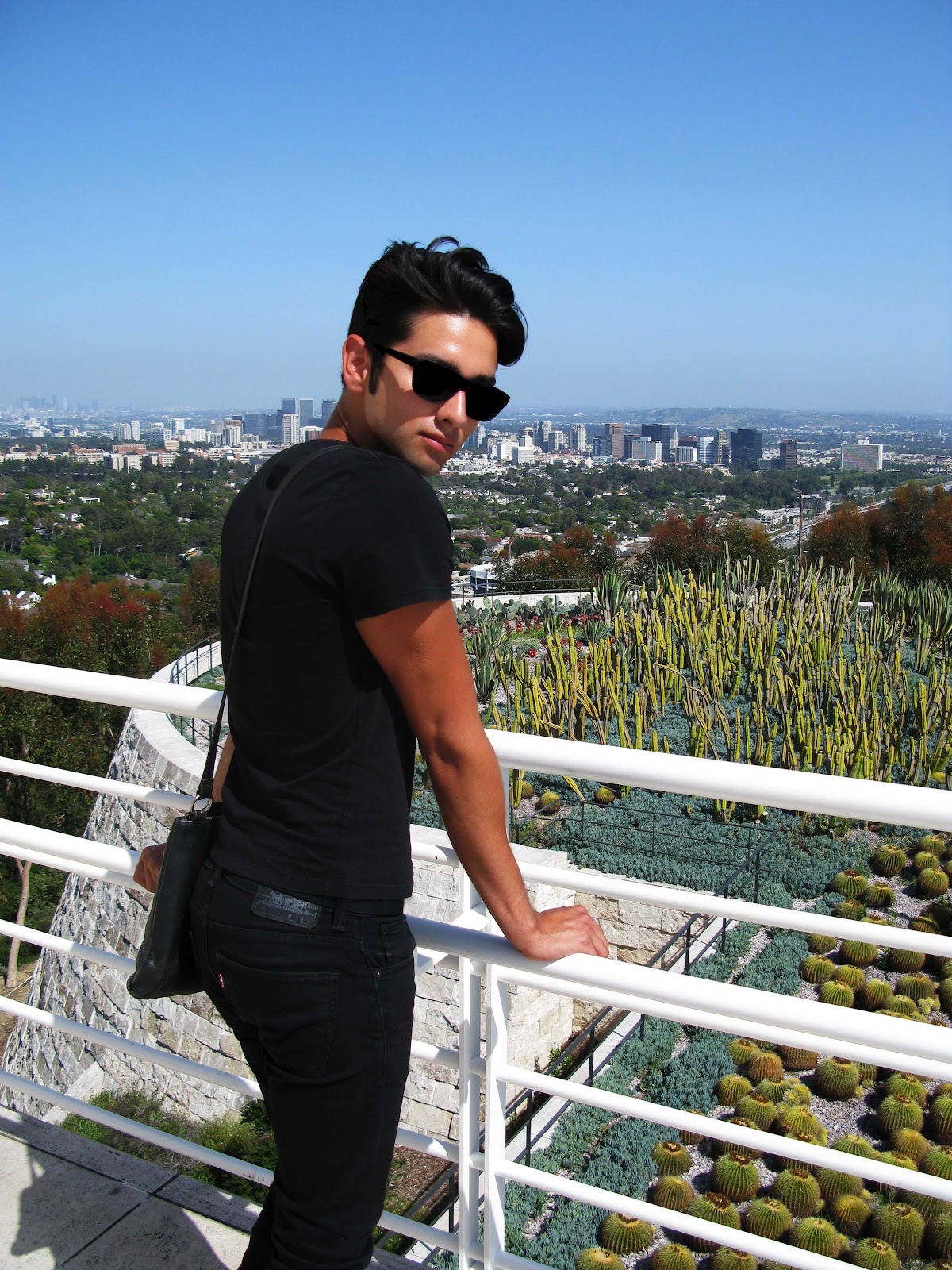
My date, Michael James, embodying the true spirit of L.A. Style at the Getty Museum, LA, 2012.

The exhibit L.A. Style is on view at the Getty Museum through the end of August 2012.

For more info visit:
The J. Paul Getty Museum, Los Angeles.

Monday, May 14, 2012

"The Total Look"

Image by William Claxton of Peggy Moffitt at The Total Look, MOCA, 2012.
There is a fascinating fashion exhibit currently at the Museum of Contemporary Art, Pacific Design Center location in West Hollywood, chronicling the extraordinary collaboration between the designer, his muse, and her husband (the photographer).

The designer in question is Rudi Gernreich, an LA based designer who revolutionized fashion with his innovative take on knits, his development of the tube dress, and his exploration of swimming garments. He boldly explored such concepts as the topless swim-suit and see-through garments, as well as an explosion of color and graphic paterns.

The Total Look at the MOCA, May 2012.


In Peggy Moffitt, he found both model and muse, with her waif-like figure, heavy false eyelashes and  make-up, and her 'five-point' pixie hair-cut, Moffitt was the it-girl of the 1960's, and willing to help Gernreich push the boundaries with his outre designs. She made national headlines in the mid '60's when she posed in Gernreich's topless bikini, known as the 'monokini'.

The Total Look at the MOCA, May 2012.
 The third member of this 20 year long collaboration was Moffitt's husband, the photographer and artist William Claxton, who carefully preserved all of the bold looks in countless photographs and videos.

Through the end of May 2012, this collaboration is on full view at the MOCA. Dozens of designs are on display, showing the excitement of the moment, and the degree of their collaboration. Original Gernreich pieces are on display next to fashion shoots by Claxton of Moffitt wearing the items back in the day.

The Total Look at the MOCA, May 2012.

It is intriguing to see how thoroughly Gernreich designed his looks, from the garment to the headpiece to the shoes and accessories. Clear vinyl dresses contain only three strategically placed polka-dots, or nude body suits feature what appears to be a knitted bikini on top of it, but is actually a one-piece body-suit. Further, it is a pleasure to see how naturally Moffitt embodies the designs, not only wearing them but living them, complete with enormous silk rose earrings or matching one-inch kitten-heels. And then there is Claxton, who painstakingly documents every look for posterity.

It seems a perfectly harmonious collaboration between designer, model/muse, and photographer. Interestingly, after Gernreich's death in 1985, Moffitt retained legal rights to many of his designs and original designs, and continued to promote his work through books and exhibits, including this one at MOCA. When I asked the museum attendant what ever happened to Ms. Moffitt, I was thrilled to learn that she is alive and well, living right here in West Hollywood, and that she had even stopped by the museum a few days before to see the exhibit.

The concept this exhibit really emphasizes is the importance of creative collaboration. Often when we see a beautiful image of a striking woman in a magazine wearing something amazing, it is easy to forget how many artists were involved in bringing this image into existence. Here, 'The Total Look' shows us at least three key players: the designer, the model/muse, and the photographer.

If you are in the LA area, and want to see the exhibit, you had better hurry, as it ends soon.

The Total Look at the MOCA, May 2012.

The exhibit, "The Total Look: The Creative Collaboration between Rudi Gernreich, Peggy Moffitt and William Claxton" is on view now at the Museum Of Contemporary Arts, Pacific Design Center, in West Hollywood through 20 May 2012.

For more info: http://www.moca.org