Thursday, October 27, 2011

"Keith Haring Pop Shop"

Keith Haring, Pace Prints, NYC, 2011.
Pace Prints (Gallery) in NYC is currently presenting a collection of prints from the illustrious and infamous Keith Haring (through December 3, 2011). The work of the iconic pop graffiti artist still seems relevant today, some 20 years after his death. In actuality, save for perhaps his absence on subway cars and sides of random buildings, Haring's work is more omnipresent than ever, instantly recognizable, and thoroughly entrenched within the establishment which he once rallied against.

Keith Haring, Pace Prints, NYC, 2011.
From the streets of Chelsea, it might be easy to miss the 3rd floor print division of Pace Gallery. It would seem that Pace is taking over the neighborhood with multiple addresses and exhibits at any given moment. But there, blinking above the High Line park, that shiny beacon of neon caught my attention, and lured me up to find out what this Pop Shop was all about.

Keith Haring, Pace Prints, NYC, 2011.
The collection of prints on view is gorgeous, and delivers everything a Keith Haring fan might expect to see. Including an amazing large-scale print in black and white illustrating the multifaceted portrait which could be any of us. Again, the only word to use for the work of the artist who's career was cut short by AIDS, is iconic. Is is unmistakably Haring.
Keith Haring, Pace Prints, NYC, 2011.
In his abbreviated lifetime, Haring explored graphic impact through his line drawings and paintings of the mostly male form in various states of interaction with himself and others. During 80's era NY, when the galleries and museums ignored the young artist, he took his work to the street, painting on any available surface, and thereby transforming the art world.

Keith Haring, Pace Prints, NYC, 2011.
An early victim of HIV, Haring transformed his revolutionary work into a statement of sexual liberation and a further attack on the establishment, which at the time was turning a blind eye to the ravaging effects of HIV and AIDS on the gay and artistic communities, which were often one and the same.  Some of his work became graphic by both definitions of the word, giving a voice and imagery to a movement.

Keith Haring, Pop Shop, Pace, NYC, 2011.
Having taken his art to the street, the next step for Haring was to bring it to the people. Once he started enjoying some commercial success, Haring opened his Pop Shop in 1986 in downtown Manhattan, democratizing fine art by emblazoning various items with his undeniable imagery.  Pace carries on this tradition with its Pop Shop installation, a side gallery full of Haring inspired (and presumably licensed) merchandise.
Keith Haring, Pop Shop, Pace, NYC, 2011.
And who better to appropriate Haring's graphic design than downtown maven Patricia Field. Scarves, leather jackets, bijoux, and even evening gowns express the collaboration between House of Field and the Haring Foundation. As my first job in NYC was Beauty Manager and Wig Stylist for the Patricia Field boutiques, it is easy to recognize here, Field's flair for the flashy and trashy, expressed through Haring's graphic sensibility.
Keith Haring, Pop Shop, Pace, NYC, 2011.
My favorite interpretation and application was the shoe collection from British designer Nicholas Kirkwood. Somehow it felt appropriately applied and fitting, as if Haring himself had taken a magic marker and beautified a stiletto.

But all of this use of Haring's 'art' two decades after his death got me to thinking: Is this really what Haring would have wanted done with his work? Was this really the direction into mass-marketing and commercialism the artist, once considered an outsider and a rebel would have taken if he were still alive today?

Certainly I am not opposed to 'selling out', and have often been known to implore for someone to just show me the dotted line where I can sign, but when is enough enough and when does it become too much?

I found my answer later that same afternoon, on another block in Chelsea. As I passed the Bed, Bath and Beyond. There, it was staring at me from the window.

Kieth Haring, Bed Bath and Beyond, NYC, 2011.
And when I saw the broom and dust pan and sponge, fully licensed from the Keith Haring Foundation and executed by Casabella, I understood why the Pop Shop at Pace smacked of a souvenir stand in Times Sqaure. Haring's art has become merely a design motif, which often happens to iconic imagery, applicable to any number of products.

All I can say is good for Keith Haring and good for the Keith Haring Foundation. Hopefully the foundation is doing good things with all those royalty checks that must certainly be rolling in. Hopefully, the foundation remembers what the artist himself once stood for: activism, gay rights, ingenuity, rebellion, and a solution to some of the ills of the world. I wonder if the house-wives buying his broom know how Haring sacrificed his own body for his art, painting his naked flesh, the same flesh which betrayed him, cutting short his prolific career at the age of 31. And if not, at least Keith Haring continues to make the world a more beautiful place, one t-shirt and cleaning product at a time.

Keith Haring, Bed Bath and Beyond, NYC, 2011.

Wednesday, October 19, 2011

"Monique Lhuillier Bridal 2011"

Monique Lhuillier Bridal Fashion Show, NYC, October 2011.
Oh fashion! The rush and fuss, the glitz and the glamor, the stress and the drama, the glamazons and the paparazzi, all culminating in 7 minutes of magic, pure theatre and romantic escapism. Admittedly, I love it. And doing the Set Design for the Monique Lhuillier Bridal Fashion Show recently in NYC was all of the above and more.

Alton DuLaney, Set Design, Monique Lhuillier, NYC, Oct 2011.
Peeking behind the curtain at everything that goes into one of these productions is always a pleasure. After conceptualizing the set, the design goes to the studio, where scenic painters work laboriously to hand-paint the 14'x42'(!) back drop. Above, I art direct the project.

Monique Lhuillier Bridal Fashion Show, NYC, October 2011.
Once the back drop is finished, there is the huge production of setting up the entire show. Seating, lighting, music - all the elements that go into creating the spectacle.


Monique Lhuillier Bridal Fashion Show, NYC, October 2011.
Meanwhile, back stage the super tall, super skinny gather, where make-up and hair is carefully applied, tech rehearsals and fittings are executed, as the beautiful gowns wait patiently nearby, ready to be animated for the girls.

Monique Lhuillier Bridal Fashion Show, NYC, October 2011.
All in anticipation of that magic moment, when the lights and the music come up, and strutting down the runway comes a vision in white, the bride.
Monique Lhuillier Bridal Fashion Show, NYC, October 2011.
The Los Angeles based designer, Monique Lhuillier is a success for her pret-a-porter and her red-carpet evening gowns, but is best known for her bridal. The 2012 collection did not disappoint with beautiful silhouettes, luxurious materials, impeccable tailoring, all embellished with sparkling crystals, delicate ruffles, and the occasional feather.
Monique Lhuillier Bridal Fashion Show, NYC, October 2011.
 And before you can gasp and shout "Gorgeous!", it is ending, as all the models come out for the finale. The long line of marching brides go sashaying by, skirts flapping, as applause erupts.

Monique Lhuillier Bridal Fashion Show, NYC, October 2011.
Taken in context, the finale is the best opportunity to see the genius of the entire collection, as every woman, (and a few men) fantasize about which gown they would wear to their own wedding. And just as the last model exits the stage, it is over, just like that. The editors and the buyers rush off to other shows, and the press flocks backstage to vie for a moment of the deigner's time.

Monique Lhuillier Bridal Fashion Show, NYC, October 2011.
Well, Monique Lhuillier loves the press and the press love her. And with good reason, as she consistently delivers an outstanding product and a dream-like experience.


For more on Monique Lhuillier, check out her website:

And for more on fashion and the arts, keep reading AltonOnTheSpot!

Monday, October 10, 2011

"James Surls and Charmaine Locke"

James Surls, Jung Center, Houston, 2011.
Growing up in a small, East Texas town, one of the things that saved me was having a highly respected and renowned artist in my home town of Spendora, who was, for me, a mentor and an inspiration. Some years have passed, and we have both long-ago left Splendora, so it was a homecoming of sorts to recently be in Texas at the same time as the art exhibit of James Surls and his wife, Charmaine Locke.

My afternoon of art included all the Houston hot spots, The Menil, Rothko Chapel, the Cy Twombly Gallery, The Museum of Fine Arts Houston, and the Contemporary Arts Museum, which was proudly displaying its own James Surls sculpture out front.

James Surls, CAM, Houston, 2011.
The Contemporary Arts Center, or the CAM, located in the Montrose District of Houston, is just next door to the Jung Center, where the Surls/Locke exhibit was featured, so it made a perfect introduction to what awaited. Surls' pieces have an uncanny knack for fitting perfectly into their surroundings. The stainless steel structure positioned against the backdrop of the museum, is a perfect example.

In addition to the monumental works and pieces designed to be outdoors, Surls also produces work on a more approachable scale including small sculptures and drawings, which were both featured in the exhibit at the Jung Center, located at 5200 Montrose, in Houston, Texas.
James Surls, Jung Center, Houston, 2011.
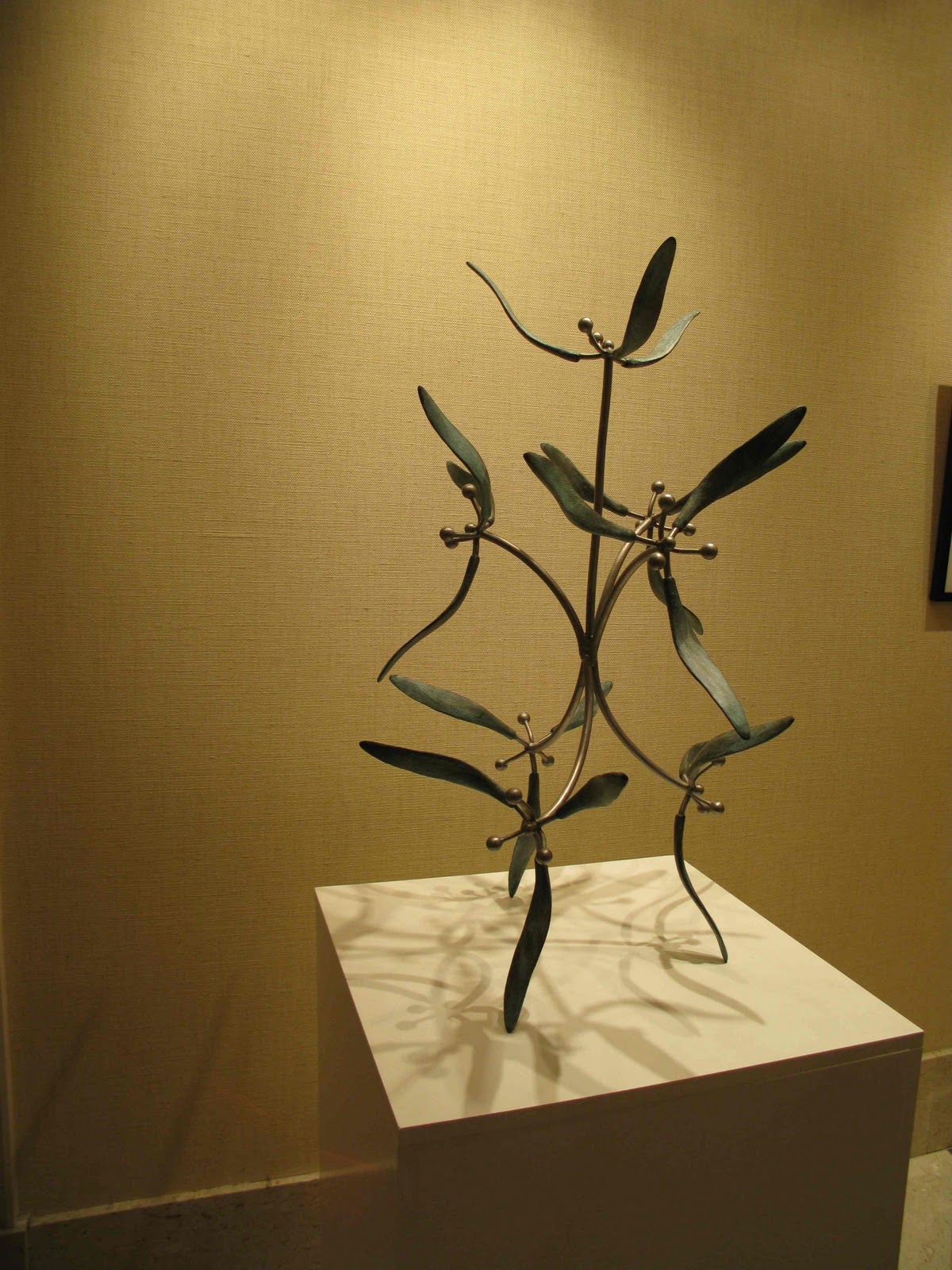
There, his familiar themes show up again and again in his work (and in the three books covering his career). Abstract flowers (above), knives, hands, diamonds, tools, and the ubiquitous eye, all make appearances in the work on display.
James Surls, Jung Center, Houston, 2011.
It is one of the symbols I remember strongly from those long days spent in Surls enormous studio in Splendora, that eye, peering at me from multiple sculptures and drawings, as if it had its own perceptive qualities. For the visual artist, the eye just about says it all, as it is the source and the portal for the majority of creative works. James Surls uses the eye, simplistic and obvious, spinning out in a whirling vortex of flower petals, piercing and penetrating, returning the gaze back at the viewer.


Surls' work is also self-referential, another creative device employed which communicates an honesty from the artist. Whether it is the ax or the knife, he acknowledges his materials including his heavy use of wood, which grew so abundantly in the Big Thicket region of Splendora, combining it with the fortitude and masculinity of forged metal.

And Surls' is, above many things, a masculine artist. His choice of material and statement, his own myth and legend as the father of seven daughters, his sturdy build and the timbre to his voice. But even more, he is a story teller, and each piece carefully tells a story, most often the story of the female essence. As he pointed out in the talk he gave at the Jung Center, women appear in much of his work, either physically or descriptively, (frequently incorporated into his titles is 'she' and 'her'). And then, upon further observation, it exists within his seemingly masculine art, such as in the sculpture featuring needle and thread.

James Surls, Jung Center, Houston, 2011.
The needle and thread piece, shown above, epitomizes his work on many levels. The material is consistent with the Surls' canon of work, so is the reference to tools, and the eye, this time manifesting in the eye of the needle. It is undeniably brutally masculine while still arguably delicately feminine.

Beyond the influence of Surls seven daughters, probably the most powerful woman in his life is his wife, fellow artist Charmaine Locke.
Charmaine Locke, Jung Center, Houston, 2011.
Locke, an accomplished artist in her own right, has a body of work reflecting the entire feminine domain, often referencing home, nesting, domesticity, and the unspoken power of that which is woman. Her nearly life-sized drawings on display at the Jung Center all embody the female form as expressed through the Goddess. Large drawings on paper, with figure prominently positioned in the center of the space, are filled with symbolism of femininity: the tea pot and cup, lilies and other flowers, the fertility of nature.

James Surls, Jung Center, Houston, 2011.
And although the work of these two artists seem worlds apart, after some studying it becomes clear that this is two sides of the same creative stories, told from two different perspectives but using many of the same words.

In the end, the exhibit, entitled "The Dance of Life", and on display through October 29, 2011, shows how these two artists and partners have moved through this life, engaged in a creativity and a dance that is all their own.
James Surls and Charmaine Locke, Jung Center, Houston, 2011.

From my own selfish standing, I am just thankful that they were there in Splendora when I needed them. Artists to show that you can chose to live a creative life, and be financially and critically successful at it in the process. They taught with encouraging words, through creative output and by being an inspiring example.

For more on the Jung Center in Houston:
http://www.junghouston.org/

See more of James Surls
http://www.jamessurls.com/

And for Charmaine Locke
http://www.charmainelocke.com/

Tuesday, September 27, 2011

"Marfa, Texas"

Marfa, Texas, 2011.
After years of threats, I have finally made the artist's pilgrimage to Marfa,  the tiny town in far West Texas where a few artists with a powerful creative vision made their own utopia of sorts by reclaiming and reinventing a nearly abandoned spot on the map in the middle of the high desert.

Prada, Marfa, Texas, 2011.
I was already half-way there, being in my home town of Splendora, Texas, only to realize it was still an exhausting 11 hour drive, without ever leaving Texas soil.  A shortcut was determined, flying Houston to El Paso, where still it is a nearly 3 hour drive.

Luckily, there is a road side attraction along the way, a prize for not letting the monotony of the landscape hypnotize the driver. As one glides silently through the sand and sun, a mirage appears. For the intrepid New Yorker and professional window dresser it might be hard to believe, but there on the outskirts of Valentine, Texas, next to nothing, is Prada Marfa. Created by artists Elmgreen & Dragset, along with a team of architects and art foundations, is the permanent installation of a storefront, complete with signage, shoes, and handbags. Installed in 2005, it has became it's own myth and legend, appearing everywhere from photographs to Gossip Girl, and yet there are those that still believe it to be a hoax.

Well, it's not, it's there, it's art.

Upon entering the town of Marfa, 20 or so minutes later, one is at first struck by the elegance of the architecture, cool gray cement coated adobe, xeroscaped yards, and an Americana that was once popular in small towns everywhere. The difference here is the artistic sensibility. It's everywhere. Many of the local businesses have also adopted the look, including The Thunderbird Hotel, where I thought I was staying.
Thunderbird Hotel, Marfa, Texas.
The Thunderbird Hotel is a project from the hotelier Liz Lambert, who has the beautiful San Jose in Austin as well as other properties. Rumor has it that Liz is no longer the proprietor, having opened El Cosmico trailer park up the road, which happens to be hosting the big music festival the weekend I am there, however Liz's distinctive style  permeates not only the Thunderbird, but has spread to other parts of town. Here I meet my friend and host Adrina Miller, who has planned a full itinerary for my weekend visit, but before I can get too comfortable, she shows me my transportation for the festivities, a bike, and points me up the hill to where I'll be staying, an office/gallery just off San Antonio Street.

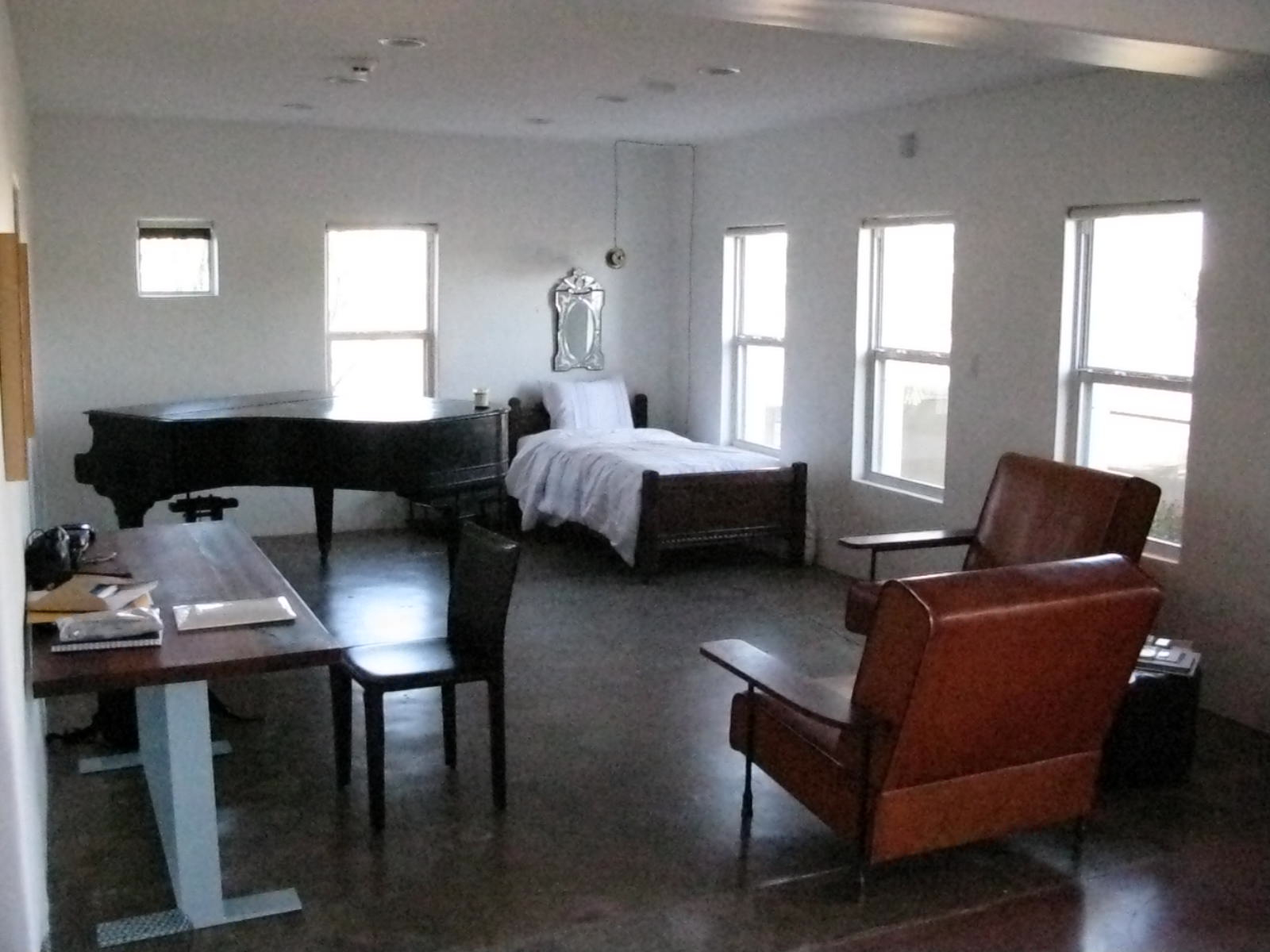
My Accommodations in Marfa, Texas.
I found it an appropriate abode, the artist installed in the gallery, complete with grand piano and plate glass window. Just as I was settling in, it was time to get out and about, as the festivities were already underway.
Gail Chovan for Blackmail, Marfa, 2011.
First stop was to make an appearance at the trunk show for the talented Gail Chovan for Blackmail. In a large screened in porch, she was showing her latest collection, '14',  hand-painted frocks, adding a splash of vivid blue to her signature black.

The champagne started flowing then, and seemed to continue for the rest of the weekend, including over dinner at the delicious Miniature Rooster, from acclaimed chef Rocky Barnette, located just across the street from my new address.

Saturday morning, we mounted our bikes, and set out to see the rest of the area by the light of day. Remarkable in Marfa, is how Donald Judd deftly took over major portions of the town. The artist first visited Marfa while stationed at a nearby military base, and later, when he had acheived art world success in NYC, he returned with a few choice friends and began purchasing buildings.

Judd Property, Marfa, Texas, 2011.

A bank becomes a gallery, a shed becomes an architecture office, a state building becomes arts administration, and a super market becomes a studio.

Judd Property, Marfa, Texas, 2011.

But Donald Judd's most impressive acquisition is the military base on the edge of town, which, along with some help from the Dia Foundation, transformed the abandoned base into an unbelievable testament to contemporary art.

The Chinati Foundation, Marfa, Texas, 2011.

Donald Judd founded the Chinati Foundation with help from the Dia Arts Foundation of New York, on 340 acres of the former Fort Russell. The transformation began in 1979, and officially opened in 1986, marking its 25th anniversary this year. (2011.)

Donald Judd, Chinati Foundation, Marfa, Texas, 2011.
 The concept of the foundation is to show the work of a small group of contemporary artists, with an attempt for the art to both compliment and accentuate the surrounding nature. Above, Judd's concrete  pieces are scattered about a field, forming a 1 kilometer long installation, with cows grazing along side it.
Donald Judd, Chinati Foundation, Marfa, Texas, 2011.
 Within the former industrial structures, Judd's 100 aluminum boxes perform a dazzling interplay with the West Texas sunlight.
Dan Flavin, Chinati Foundation, Marfa, Texas, 2011.
 Speaking of light, the light artist Dan Flavin is also represented here. In 6 U-shaped former army barracks, Flavin has installed his neon tubes, with jarring subtlety, inviting both exploration and interaction.
Dan Flavin, Chinati Foundation, Marfa, Texas, 2011.
 The interplay of light illuminates the long corridors of the barracks, bouncing off white walls and polished concrete floors.
Claes Oldenburg & Coosje Van Bruggen, Chinati Foundation, Marfa, Texas, 2011.
 There are a select few other artists represented at the Chinati, including Clase Oldenburg, who created an over-sized horseshoe, paying tribute to a military horse, which was shot on the spot in a military ceremony. The inspiration for the piece, an actual horseshoe found on the grounds, years after the event.
John Chamberlain, Chinati Foundation, Marfa, Texas 2011.
 Back in town, next to the train tracks, the Chinati also has a huge space dedicated to the work of John Chamberlain. His crumpled car sculptures, perfectly embody both American and the rusted metallic sentiment of high desert.
John Chamberlain, Chinati Foundation, Marfa, Texas 2011.

The Chinati Foundation has 25 of the Chamberlain pieces, each vaguely nostalgic  work gently provokes with a promise of danger, force, and strength.


Judd Foundation, Marfa, Texas, 2011.
 Next stop is the Judd Foundation, which includes the residence and studios of Donald Judd. Here his obsession with right angles and the square is prevalent in everything from the swimming pool and outdoor furnishings...
Judd Foundation, Marfa, Texas, 2011.
...to his numerous works on display in various galleries, from the shape of the windows and buildings themselves....
Judd Foundation, Marfa, Texas, 2011.
 ....to the fire pit and walls of the grounds, from the organized engineering of his library.....
Judd Foundation, Marfa, Texas, 2011.
.....to the furniture he designed and built for the Foundation.


But the beauty in Marfa is that artists continue to keep the spirit of creativity alive here, beyond Judd and his contemporaries. Homes are beautiful restored and decorated, gas stations are converted into galleries, even the hip restaurants (a choice few) and boutiques have the unmistakable influence of art.

"Imaginary Funerals", Lorna Leedy, Fancy Pony Land, Marfa, Texas, 2011.
One such boutique/gallery is Fancy Pony Land, where I even discovered a piece of art about me. Artist and designer Lorna Leedy, has created a series of "Imaginary Funerals" with a guest list chosen from a questionnaire sent to each contributing artist. I quickly purchased the self-referential piece, being not only an artist, muse, and model, but also a patron. Lorna has just completed a book on the series which is available through her website.
Lorna Leedy, Fancy Pony Land, Marfa, Texas, 2011.
 Lorna also has a fascination with the penny, and through utilizing the proximity of the train track, she smashes the coins into copper discs which she incorporates into jewelry and other decorative uses. (Growing up near the railroad in Splendora, putting coins on the track was a favorite summer hobby of my own, so the work she creates has a sentimentality that I can't deny.) Above, Leedy has used the penny as a bathroom floor covering in one of many applications
Adrinadrina, Marfa, Texas, 2011.
Two doors down, artist (and my host) Adrina Miller, aka Adrinadrina, was cleaning out her studio space, and along with neighbors we all enjoyed a cold Shiner Bock beer and allowed the heat of the day to subside.

Alton Dulaney, Marfa, Texas, 2011.
Seemingly around every corner and in every reclaimed space of Marfa art continues to thrive. What was once a dry and barren near-ghost-town, has become a fertile oasis for creativity.

For more info on Prada Marfa, visit:
http://ballroommarfa.org/archive/event/prada-marfa/

For the Thunderbird Hotel visit:
http://thunderbirdmarfa.com/

For Gail Chovan for Blackmail:
http://www.blackmailboutique.com/

For the Miniature Rooster and Rocky Barnette:
http://www.miniaturerooster.com/

For the Chinati Foundation see:
http://www.chinati.org/

For the Judd Foundation:
http://www.juddfoundation.org/

For Lorna Leedy and Fancy Pony Land:
http://fancyponyland.com/

For Adrinadrina check out:
http://www.adrinadrina.com/

And for me, well sign up to follow this blog, be my friend on Facebook, check out my website, You-Tube my name, write me a letter, or otherwise, just stay tuned for more on the arts in all the many shapes and forms.